

Executive Summary: The Pedagogy vs. Chatbot Thesis
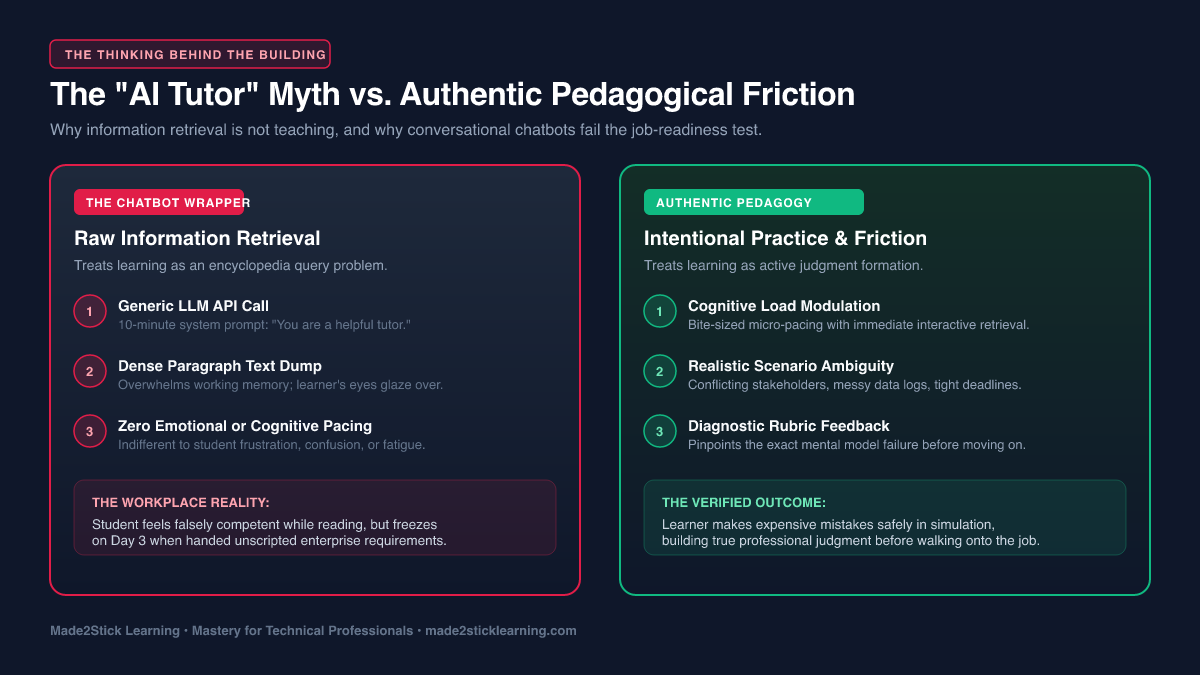
Teaching has never been an information retrieval problem. Wikipedia and search engines solved raw information access twenty years ago. When edtech vendors slap a generic LLM wrapper on a textbook and call it an "adaptive AI tutor," they confuse text generation with cognitive assimilation. Authentic pedagogy requires intentional cognitive pacing, emotional safety, managing learner frustration, and designing active failure loops where students wrestle with realistic ambiguity. Real learning happens through guided practice, not passive chatbot conversation.
1. The Information Retrieval Fallacy #
Over the past eighteen months, the education technology sector has been flooded with "AI Tutors." Almost all of them share the exact same underlying architecture: a 10-minute system prompt instructing a large language model to "act as a patient, encouraging tutor", connected to an API that accepts questions and returns paragraphs of generated prose.
The unexamined assumption behind these products is that students fail to learn because they lack access to explanations.
That premise is demonstrably false. Wikipedia solved information access in 2001. YouTube made every conceivable math, programming, and engineering lecture free in 2005. If access to clear explanations were the bottleneck to human competence, everyone with a smartphone would already be an expert programmer and seasoned project leader.
Students do not freeze when learning because the definition of a concept is hidden. They freeze because their working memory is overloaded, because their prior mental model contains an undetected misconception, or because the emotional friction of feeling confused causes them to disengage.
2. What Real Teaching Demands (The 4 Non-Textual Pillars) #
Anyone who has sat across a table from a struggling 8-year-old trying to understand fractions, or coached an adult career switcher debugging their first SQL join, knows that teaching is an intensely human discipline governed by four non-textual variables:
- Micro-Pacing: Knowing exactly when to introduce a new constraint and when to pause. Dumping five paragraphs of explanation onto a confused learner guarantees cognitive shutdown.
- Glaze Detection: Recognizing the exact micro-second a learner's eyes glaze over. A skilled instructor stops immediately, discards the planned lesson, and backs up to the last stable concept. A chatbot simply keeps generating tokens.
- Emotional Safety: When adults learn complex skills (such as CDISC data standards or Earned Value Management formulas), their biggest obstacle is fear of looking incompetent. Creating a psychologically safe environment where making mistakes is normalized is 80% of the battle.
- Active Retrieval under Ambiguity: True retention does not happen when you read an answer. It happens when you are forced to retrieve a principle from memory and apply it to an unscripted, imperfect problem.
3. The Illusion of Competence #
Chatbots create a dangerous cognitive illusion: the illusion of competence.
When an AI tutor politely explains a complex problem step-by-step, the learner reads along, nods their head, and feels an immediate surge of comprehension. But this is passive recognition, not active mastery. It is the educational equivalent of watching an Olympic gymnast perform on television and assuming your muscles now know how to do a backflip.
When that same student sits down at a real workstation on Monday morning, with no AI prompt box and an angry stakeholder asking why the production database crashed, the illusion evaporates. They freeze.
4. The Alternative: Engineering Authentic Pedagogical Friction #
I am not anti-technology. At Made2Stick Learning, we leverage artificial intelligence every single day. But our architectural philosophy is inverted:
Do not use AI to explain things to passive learners. Use AI to build realistic, messy workplace environments (simulations) where learners must actively make decisions, defend their choices to synthetic stakeholders, and confront the real-world consequences of their errors.
In our WorkReady simulations, learners are not given multiple-choice quizzes or cheerful conversational summaries. Instead, they are dropped into an active clinical trial or enterprise software project. They receive urgent emails from virtual project leads, review dirty raw datasets, and must write compliant code or adjust project baselines under realistic constraints.
5. The Guiding Test for Educational Technology #
Before we build or adopt any new learning feature, we subject it to a simple test:
"Does this tool make the learner think harder, or does it do the thinking for them?"
If a technology does the thinking for the student, it is not an educational tool. It is an outsourcing tool. Outsourcing is fine for routine administrative workflows. But in education, when you outsource the friction, you eliminate the learning.
Education deserves far more respect than hurried API wrappers and generic chatbot prompts. The future of learning is not conversational chatbots that talk at students. It is immersive simulations that let students safely experience what it actually feels like to do the job.