
CDISC SDTM vs. ADaM: Core Differences, Domains & Datasets Architecture
The essential guide to CDISC SDTM tabulation datasets (DM, AE, VS, LB) vs. ADaM analysis-ready datasets (ADSL, BDS).
Direct Answer / Executive Definition
CDISC SDTM (Study Data Tabulation Model) is a standardized regulatory format for organizing raw clinical trial observations collected on Case Report Forms (CRFs) into structured SDTM datasets (such as DM, AE, EX, LB, and VS) with minimal transformation. CDISC ADaM (Analysis Data Model) transforms those SDTM domains into analysis-ready datasets (such as ADSL and BDS datasets ADAE, ADLB, ADTTE) containing derived endpoints, baseline values, imputed dates, and population flags so statistical procedures (PROC FREQ, PROC MEANS, PROC LIFETEST) execute with one-step traceability.
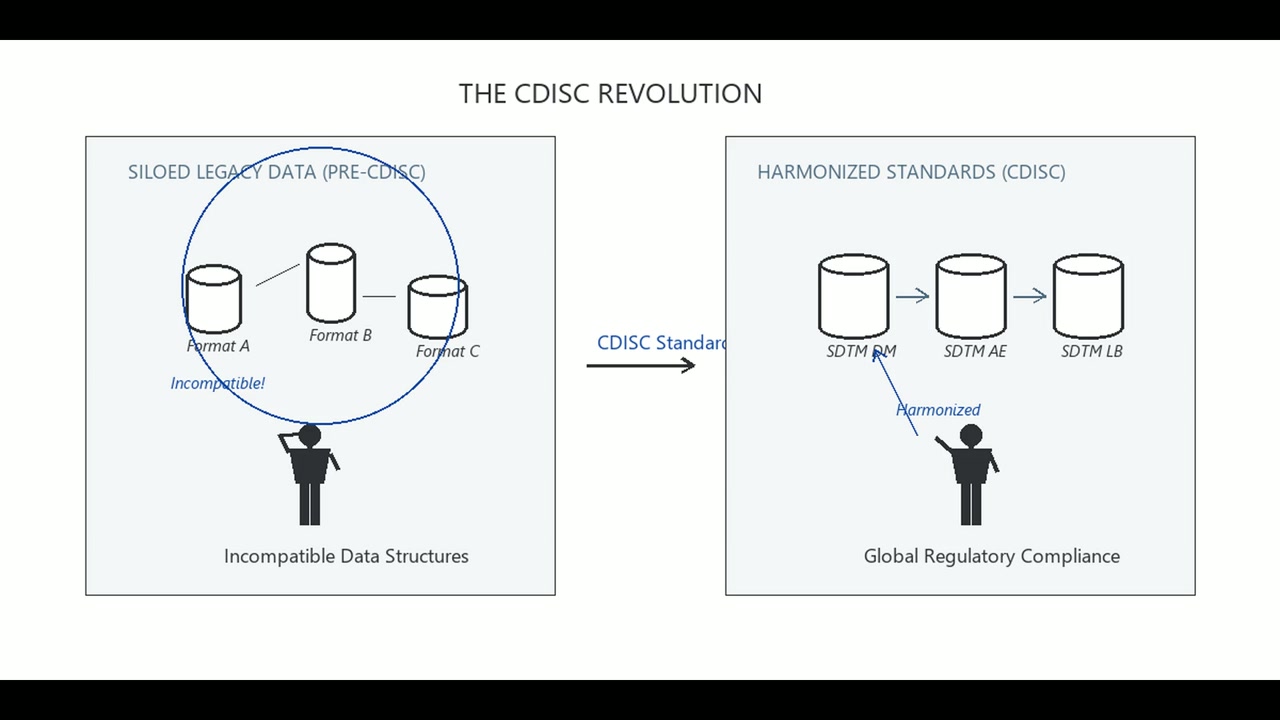
Why CDISC SDTM & ADaM Standards Matter for FDA Submissions
Both CDISC SDTM and ADaM datasets are mandated by the US FDA, Japan PMDA, and European EMA for electronic drug submissions (eCTD). Understanding the boundary between raw tabulation (SDTM) and statistical derivation (ADaM) is the #1 core competency tested in Clinical SAS technical interviews.
Standard Syntax, Derivation & Framework Pattern
/* SDTM to ADaM Derivation: Transforming SDTM.DM + EX to ADaM.ADSL */
DATA work.adsl;
    MERGE sdtm.dm(IN=in_dm) sdtm.ex(IN=in_ex);
    BY USUBJID;
    IF in_dm;

    /* ADaM Standard Variable Derivations */
    TRT01P = ARM;               /* Planned Treatment */
    TRT01A = ACTARM;            /* Actual Treatment */
    TRTSDT = INPUT(EXSTDTC, IS8601DA.); /* Treatment Start Date */

    /* Deriving Subject Age in Years at Baseline */
    IF BRTHDTC NE '' AND RFSTDTC NE '' THEN
        AGE = FLOOR((INPUT(RFSTDTC, IS8601DA.) - INPUT(BRTHDTC, IS8601DA.)) / 365.25);
RUN;
Core Rules
- SDTM Datasets (Tabulation): Preserves raw observations grouped into general observation classes—Interventions (EX, CM), Events (AE, DS, MH), Findings (LB, VS, EG), and Special Purpose (DM, CO, SE).
- ADaM Datasets (Analysis): Optimized for statistical analysis and consists of three core structures: ADSL (Subject-Level Analysis Dataset), BDS (Basic Data Structure for ADLB, ADVS, ADTTE), and OCCDS (Occurrence Data Structure for ADAE, ADCM).
- One-Step Traceability Rule: Every derived variable in an ADaM dataset must be clearly traceable back to its source SDTM domain in define.xml metadata (via SRCDOM, SRCVAR, and SRCSEQ).
- Never run regulatory CSR summary procedures directly on SDTM datasets; always derive and validate ADaM datasets first.
Understanding SDTM vs ADaM in Clinical SAS: A Practical Comparison
Side-by-side comparison of SDTM domains (DM, AE, VS, LB) vs. ADaM datasets (ADSL, ADAE) and FDA traceability rules.
Related Architectural Concepts & Next Steps
Deepen your mastery with connected topics across our curriculum and knowledge hubs.
Frequently Asked Questions (FAQ)
What are the main CDISC SDTM datasets in a clinical trial?
Core SDTM datasets are organized by domain class: DM (Demographics), SE (Subject Elements), EX (Exposure), CM (Concomitant Medications), AE (Adverse Events), DS (Disposition), MH (Medical History), LB (Laboratory Test Results), VS (Vital Signs), and EG (ECG Test Results).
What is the main difference between SDTM and ADaM datasets?
SDTM datasets tabulate raw CRF clinical data in a standardized horizontal/vertical format without statistical derivations or imputations. ADaM datasets merge SDTM domains with subject-level metadata (ADSL dataset) and add derived analysis variables (AVAL, BASE, CHG, ABLFL, SAFFL, TRTEMFL) for direct TLF reporting.
Can you generate CSR tables directly from SDTM datasets?
No. Regulatory agencies (FDA/EMA/PMDA) mandate that Clinical Study Report (CSR) summary tables and statistical models be generated from validated ADaM datasets to guarantee one-step traceability and consistent population denominators.
Where can I see a visual comparison of SDTM vs ADaM in Clinical SAS?
Read our companion visual walkthrough: Understanding SDTM vs ADaM in Clinical SAS: A Practical Comparison, and our lineage blueprint: The Beginner's Guide to CDISC Data Lineage.
Want complete video breakdowns & exercises?
Explore full step-by-step masterclass training in Clinical SAS Programming & Clinical Trials.