
SAS INFORMATS vs. FORMATS & PROC FORMAT Custom Mappings
Understand how SAS reads raw data into internal values and renders visual representations.
📌 Direct Answer / Executive Definition
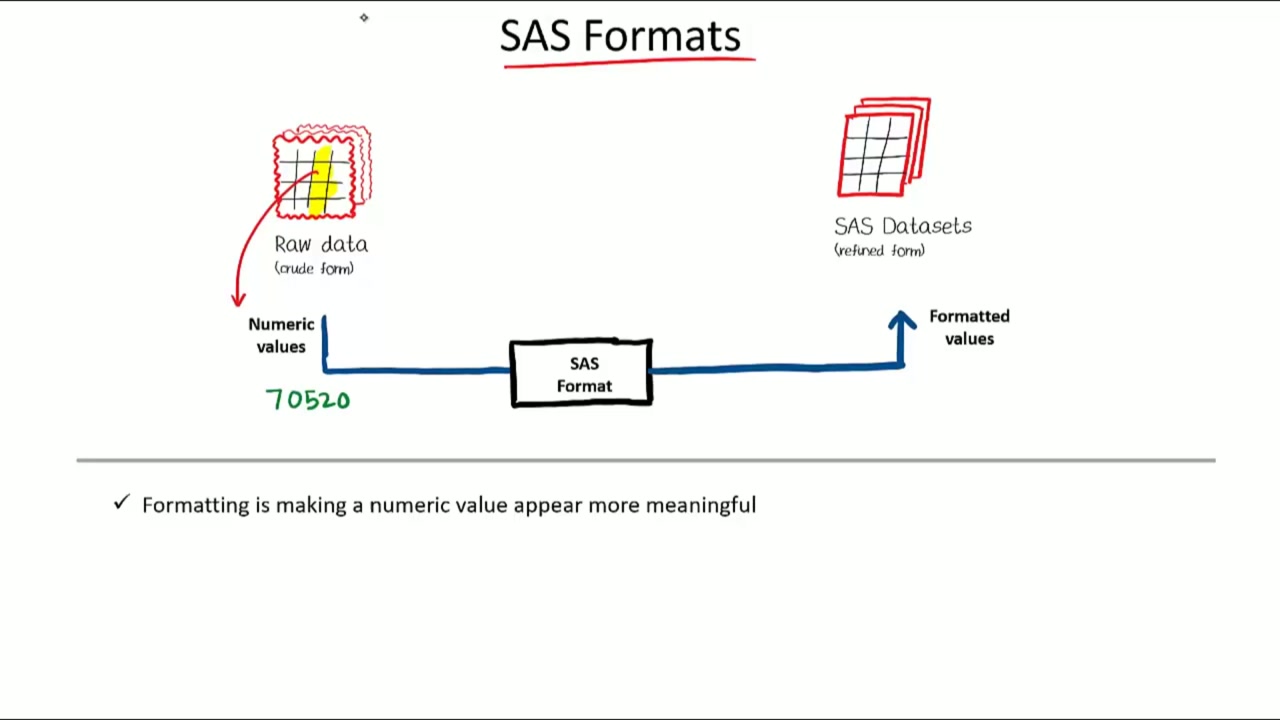
An INFORMAT instructs SAS how to read raw input data into internal numeric or character variables (Input). A FORMAT instructs SAS how to display stored values on screen and reports (Output). PROC FORMAT creates custom user-defined formats to categorize continuous variables or decode numeric codes into human-readable labels.
Why Ingestion INFORMATS & Formats Matter for Data Hygiene
Essential for handling dates, timestamps, currency symbols, and clinical trial visit codes without altering the underlying raw data precision.
Standard Syntax, Derivation & Framework Pattern
/* Creating Custom Formats and Applying Formats */
PROC FORMAT;
    VALUE $gender_fmt
        'M' = 'Male'
        'F' = 'Female'
        OTHER = 'Unknown';

    VALUE age_grp
        LOW - 12 = 'Child'
        13 - 15  = 'Young Teen'
        16 - HIGH = 'Older Teen';
RUN;

DATA work.formatted_class;
    SET sashelp.class;
    FORMAT Sex $gender_fmt. Age age_grp.;
RUN;
Core Rules & Certification Takeaways
- INFORMAT = Ingesting/Reading data. FORMAT = Presenting/Displaying data.
- All format and informat names must end with a period (.) in SAS statements.
- Character formats must always start with a dollar sign ($).
- Applying a FORMAT changes only how the data looks in output and procedures; the underlying stored value remains untouched.
🔗 Related Architectural Concepts & Next Steps
Deepen your mastery with connected topics across our curriculum and knowledge hubs.
Frequently Asked Questions (FAQ)
What is the key difference between an INFORMAT and a FORMAT in SAS?
An INFORMAT converts raw external data into internal SAS binary storage. A FORMAT takes internal SAS values and displays them as formatted text strings on reports.
Why must format names end with a period?
The trailing period (.) signals to the SAS compiler that the token is a format specification rather than a standard variable name.
Want complete video breakdowns & exercises?
Explore full step-by-step masterclass training in The Simplest Guide to SAS Programming.