

Executive Summary: Code Generation vs. Regulatory Accountability
Artificial Intelligence and Large Language Models (LLMs) can generate SAS DATA steps and SQL joins in seconds, leading some to question the longevity of statistical programming careers. But in regulated pharmaceutical development, writing syntax is only fifteen percent of the job. The remaining eighty-five percent consists of interpreting complex Statistical Analysis Plans (SAPs), resolving protocol deviations, verifying CDISC SDTM and ADaM data lineage, and defending audit trails under 21 CFR Part 11. Regulators do not evaluate code elegance; they demand deterministic reproducibility and legally accountable human sign-off. AI will not replace clinical SAS programmers, but programmers who use AI for rapid scaffolding while mastering CDISC architecture will replace those who do not.
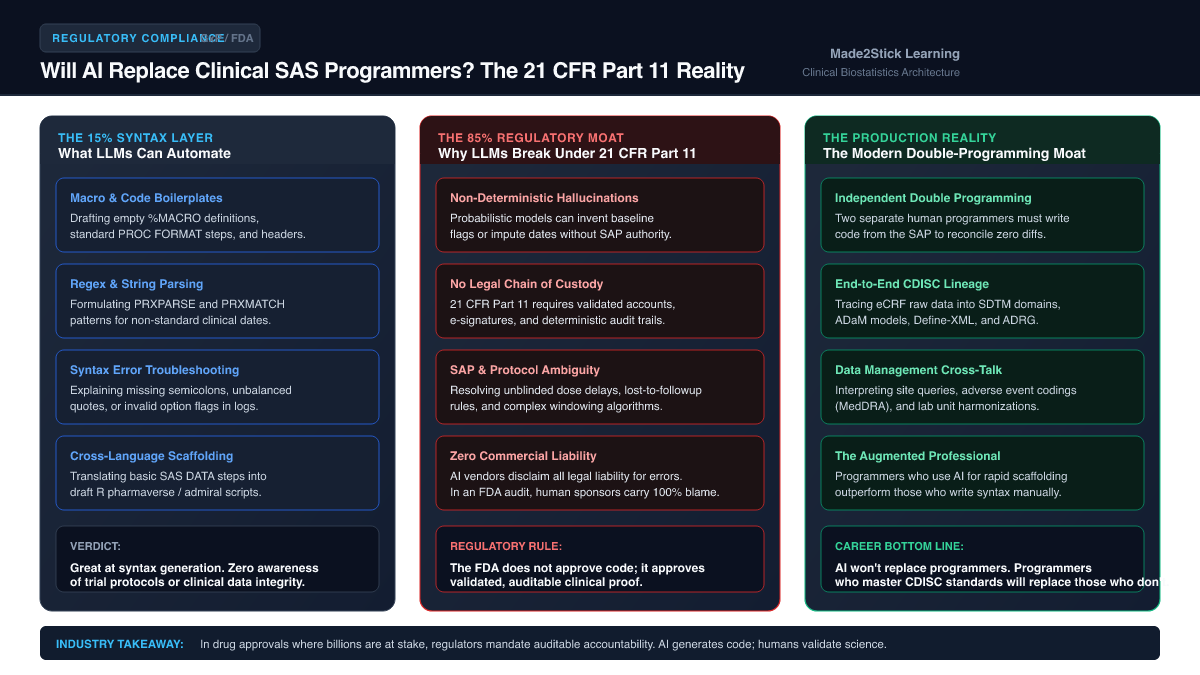
Figure 1: Regulatory Reality Matrix — Where Generative AI Scaffolds Syntax vs. Where 21 CFR Part 11 and Double Programming Create an Unbreakable Moat.
The 15% Syntax Illusion: The Flawed Automation Narrative #
If your mental model of a Clinical SAS Programmer is someone who spends eight hours a day typing out DATA statements, SET conditions, and PROC SORT options from memory, then the rise of generative AI looks genuinely alarming.
Any modern LLM can produce clean Base SAS syntax in seconds. Ask it to merge two datasets on USUBJID, transpose laboratory observations from long to wide, or write a macro that runs PROC FREQ across twenty variables, and it generates working code with near-zero hesitation.
However, programmers who work inside active pharmaceutical sponsors and Contract Research Organizations (CROs) understand an unspoken truth: syntax generation represents barely fifteen percent of the real job.
The true complexity of clinical trials does not live in typing commands into an enhanced editor. It lives in the clinical domain intelligence required to bridge messy, human reality with strict regulatory standards.
The 21 CFR Part 11 Wall: Probabilistic Code vs. Deterministic Law #
The primary reason autonomous AI cannot take over regulatory trial reporting is rooted in federal law: Title 21 of the Code of Federal Regulations, Part 11 (21 CFR Part 11), alongside Good Clinical Practice (GCP) guidelines.
Part 11 establishes binding requirements for electronic records and electronic signatures submitted to the FDA. Among its core tenets are:
- Individual Accountability: Every data transformation, derivation rule, and database edit must be tied to an authenticated, qualified human individual who assumes legal responsibility for the output.
- Deterministic Audit Trails: The regulatory pipeline must guarantee that executing the identical code against identical source data produces bit-for-bit identical results every single time, without drift or probabilistic variance.
- Software Qualification and Validation: Any computing system that derives safety or efficacy endpoints must undergo rigorous Installation Qualification (IQ) and Operational Qualification (OQ).
Generative AI models are probabilistic next-token prediction engines. They do not operate on formal deterministic logic. If a model hallucinates an imputation rule for a missing adverse event date, or silently alters a baseline definition between runs, the sponsor faces severe regulatory inspection findings (FDA Form 483) or a Complete Response Letter (CRL).
When an approval decision involves five hundred million dollars and real patient lives, pharmaceutical executives will never entrust regulatory sign-off to an open-ended algorithmic black box with zero commercial liability.
The Double-Programming Mandate: Why AI Cannot Verify Itself #
In traditional commercial software development, one engineer writes code, a second engineer reviews a pull request on GitHub, and automated unit tests pass the build.
In clinical biostatistics, this workflow is legally insufficient. Regulators mandate Independent Double Programming:
DATA work.adae_primary;
SET sdtm.ae;
IF AESTDTC >= TRTSDTC THEN TRTEMFL = 'Y';
ELSE TRTEMFL = 'N';
RUN;
/* Validation Programmer: Independently builds from SAP specification */
DATA val.adae_qc;
SET sdtm.ae;
/* Independent logic handling partial date imputation rules */
...
RUN;
/* Programmatic Reconciliation: Must show 0 differences */
PROC COMPARE BASE=work.adae_primary COMPARE=val.adae_qc CRITERION=0.00001;
ID USUBJID AESEQ;
RUN;
Two separate programmers must interpret the approved Statistical Analysis Plan (SAP) in isolation and write completely independent code. The datasets are then compared row by row and variable by variable using PROC COMPARE in SAS or diffdf in R. Every single value must match to zero discrepancy before database lock.
You cannot ask an AI to write both the primary code and the validation code. If an LLM misinterprets a nuanced footnote in an SAP mock shell, prompting that same LLM to "validate" the dataset will simply reproduce the exact same hallucination or structural error on both sides. True quality control requires independent human cognition.
The 85% Domain Moat: What Programmers Actually Do #
If writing code is fifteen percent of the work, what constitutes the other eighty-five percent?
- Resolving Messy Clinical Data Realities: A patient takes their study dose in the clinic, experiences an adverse event that evening, but the site coordinator records the event start time as occurring before dosing. An algorithm treats this as non-treatment emergent. A clinical programmer investigates the CRF audit logs, queries the data manager, and ensures proper medical categorization.
- CDISC ADaM Architecture & Traceability: Mapping raw Electronic Data Capture (EDC) files through SDTM tabulation domains and building compliant ADSL and Basic Data Structure (BDS) models with full one-step traceability down to original eCRF page variables.
- Regulatory Deliverable Documentation: Authoring the Analysis Data Reviewer’s Guide (ADRG), verifying Define-XML 2.0 schemas via Pinnacle 21, and explaining rule discrepancies directly to regulatory reviewers.
- Protocol Amendment Integration: When a sponsor modifies inclusion criteria or adjusts dosing cohorts mid-trial, programmers refactor analysis populations and windowing algorithms without breaking prior interim analyses.
The Career Formula: How to Become Irreplaceable #
The arrival of AI is not a threat to clinical programmers; it is an extraordinary opportunity.
In the past, junior developers spent weeks typing repetitive macro headers, formatting PROC REPORT table column widths, or writing tedious regex string parsing routines. Today, you can use AI to scaffold those mechanical tasks in seconds.
The winning career formula in biostatistics is clear:
- Stop competing on syntax memorization: Knowing how to type a DO-loop from memory does not make you irreplaceable. An LLM can write that loop in two hundred milliseconds.
- Compete on standards and clinical data intelligence: Master CDISC SDTM and ADaM structures, understand Statistical Analysis Plans cold, know how Table 14.1.1 Demographics and Adverse Event incidence tables are constructed, and master independent validation techniques.
- Become an augmented practitioner: Use AI to accelerate boilerplate generation, but apply human judgment and regulatory rigor to verify every single output.
Will AI Replace Clinical SAS Programmers? 21 CFR Part 11 & GxP Reality #
Review our foundational Knowledge Hub guide covering 21 CFR Part 11 compliance, deterministic double-programming rules, and CDISC regulatory moats.
Lesson 0.01: Course Orientation & Pharma Industry Intro #
Understand the drug development lifecycle, regulatory submission requirements, and why SAS remains the industry-standard tooling in biostatistics.