
Will AI Replace Clinical SAS Programmers? 21 CFR Part 11 & GxP Reality
Why syntax generation is only 15% of clinical programming, and why 21 CFR Part 11, GxP validation, and double programming keep biostatisticians irreplaceable.
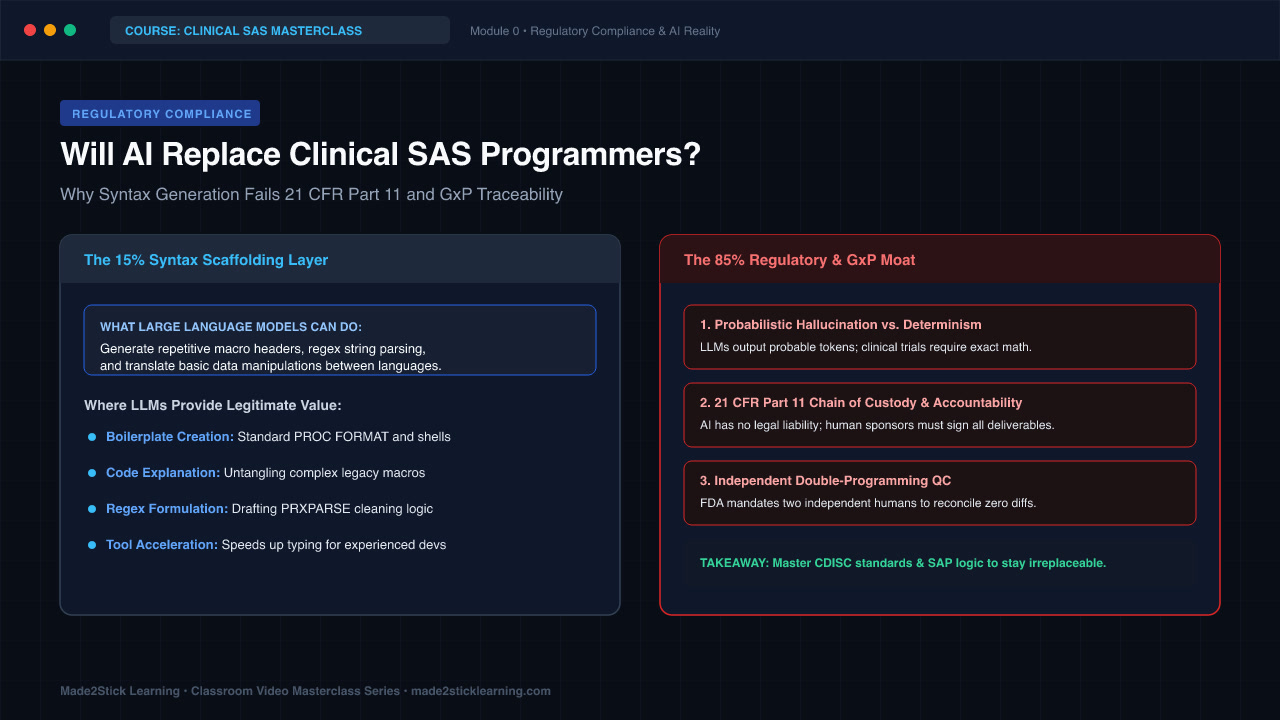
Artificial Intelligence and Large Language Models (LLMs) cannot replace Clinical SAS Programmers in regulated drug development. Under 21 CFR Part 11, Good Clinical Practice (GCP), and ICH E6 guidelines, regulatory submissions require fully deterministic reproducibility, validated user access controls, legal audit trails, and independent double-programming verification. While LLMs excel at syntax scaffolding and macro boilerplate drafting (representing roughly 15% of the role), they lack clinical protocol comprehension, cannot legally sign off on submissions, and introduce probabilistic hallucination risks unacceptable in regulatory filings.
Why Regulatory Auditability & GxP Validation Matter in an AI Era #
Novice programmers frequently fear that automated code generation renders SAS careers obsolete. In pharmaceutical biostatistics, syntax is trivial; data lineage, protocol deviation reconciliation, CDISC ADaM compliance, and audit defense represent the true engineering moat. Programmers who understand how to leverage AI for rapid code scaffolding while rigorously validating outputs according to the Statistical Analysis Plan (SAP) will replace those who rely solely on manual typing.
Standard Syntax, Derivation & Framework Pattern #
/* 1. Primary Analysis Derivation (ADAE Treatment-Emergent Flag) */
DATA work.adae;
    SET sdtm.ae(RENAME=(AESTDTC=AESTDTC_RAW));
    LENGTH TRTEMFL $1;
    /* Impute missing adverse event start dates per SAP rules */
    IF LENGTH(AESTDTC_RAW) = 10 THEN AESTDT = INPUT(AESTDTC_RAW, IS8601DA.);
    ELSE IF LENGTH(AESTDTC_RAW) = 7 THEN AESTDT = INPUT(CATS(AESTDTC_RAW, '-01'), IS8601DA.);

    /* GxP Rule: Event must occur on or after first dose date (TRTSDT) */
    IF AESTDT >= TRTSDT AND NOT MISSING(TRTSDT) THEN TRTEMFL = 'Y';
    ELSE TRTEMFL = 'N';
RUN;

/* 2. Independent Human Verification:
   Even if an LLM assists in drafting date parsing syntax,
   a second human validation programmer must independently code
   the derivation from the SAP mock shell:

   PROC COMPARE BASE=work.adae COMPARE=val.adae CRITERION=0.00001;
       ID USUBJID AESEQ;
       VAR TRTEMFL AESTDT;
   RUN;
*/
Core Rules #
- Syntax generation represents only 15% of clinical programming; 85% of the role involves protocol interpretation, CDISC data lineage, and audit defense.
- 21 CFR Part 11 and ICH E6 require deterministic reproducibility, auditable electronic signatures, and validated system environments that probabilistic LLMs cannot provide.
- Regulatory health authorities (FDA, EMA, PMDA) do not approve code syntax; they approve validated, traceable evidence supported by legally accountable sponsor signatures.
- Independent double programming remains mandatory: clinical trial datasets require two separate human programmers to independently derive and reconcile deliverables to zero discrepancy.
- AI is a productivity multiplier, not a replacement: statistical programmers who master CDISC standards and use AI for scaffolding will outpace those who manually write boilerplate.
The regulatory reality of GxP compliance, deterministic validation, the 85% domain moat, and how augmented biostatisticians work.
Frequently Asked Questions (FAQ) #
Can an LLM write a complete CDISC ADaM submission dataset?
No. While an LLM can generate individual DATA steps or SQL queries from a prompt, it cannot evaluate patient-level edge cases, read unstandardized eCRF operational notes, cross-reference study amendments, or ensure 100% compliance with Define-XML 2.0 without extensive human engineering and validation.
Why does 21 CFR Part 11 prevent autonomous AI from submitting clinical trial results?
21 CFR Part 11 mandates strict electronic records security, individual accountability, verified audit trails, and system qualification. Generative AI tools operate probabilistically and cannot legally bear regulatory liability for clinical drug trial decisions.
What skills make a Clinical SAS Programmer irreplaceable in an AI era?
Deep fluency in CDISC standards (SDTM, ADaM), understanding Statistical Analysis Plans (SAPs), clinical domain expertise (such as oncology or cardiology endpoints), independent double-programming verification, and regulatory inspection defense.
Where can I read the full technical and regulatory analysis of this topic?
Read our detailed companion article: Will AI Replace Clinical SAS Programmers? Why LLMs Break Under 21 CFR Part 11, detailing GxP auditability, double programming, and the human-in-the-loop standard.
Want complete video breakdowns, code files & exercises?
Explore comprehensive step-by-step masterclass training in our authoritative Clinical SAS Programming Course & CDISC Training.