
SAS Arrays in Clinical Trials: Batch Processing Laboratory Variables
Transform dozens of clinical laboratory parameters (ALT, AST, BILI, ALP, ALBUMIN) using 1-dimensional arrays, DIM bounds, and DO-loops.
📌 Direct Answer / Executive Definition
A SAS array in clinical programming is a temporary, in-memory grouping of existing Program Data Vector (PDV) variables referenced by a shared name and numerical subscript index. Rather than storing physical data on disk, an array provides an efficient pointer mechanism to execute iterative mathematical transformations, baseline shifts, and range validations across dozens of clinical laboratory parameters (e.g., ALT, AST, BILI, ALP, ALBUMIN) in a single unified DO-loop.
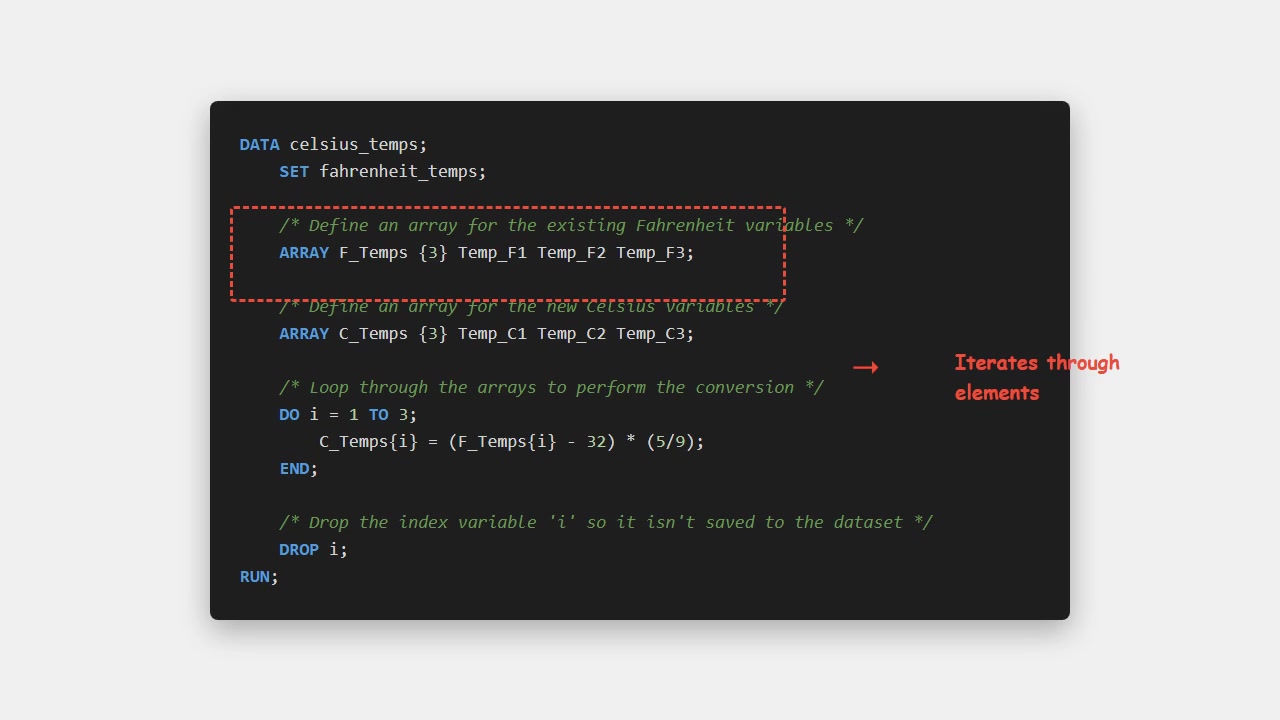
Why SAS Arrays & Batch Processing Matter in Regulated Clinical Trials
Clinical laboratory domains (SDTM LB / ADaM ADLB) frequently contain 30 to 50+ quantitative parameters per subject. Hardcoding individual assignment statements introduces severe copy-paste typo risks and breaks audit compliance. SAS arrays eliminate redundant code, protect data integrity, and adhere to regulatory Good Programming Practice (GPP).
Standard Syntax, Derivation & Framework Pattern
/* Batch Processing Clinical Laboratory Chemistry Variables */
DATA work.lab_results_clean;
    SET raw.lab_results;

    /* 1. Group clinical chemistry analytes in temporary PDV array */
    ARRAY lab_values[*] ALT AST BILI ALP ALBUMIN;

    /* 2. Iterate dynamically using the DIM() function */
    DO i = 1 TO DIM(lab_values);
        /* Check and replace missing values per protocol analysis specification */
        IF MISSING(lab_values[i]) THEN lab_values[i] = 0;
    END;

    /* 3. Drop loop counter so it never pollutes the production analysis table */
    DROP i;
RUN;
Core Rules & Certification Takeaways
- In-Memory Mechanism: A SAS array does NOT create new dataset columns or consume disk storage; it exists strictly in the PDV during DATA step execution.
- Dynamic Dimensioning: The asterisk [*] syntax paired with DIM(array_name) dynamically computes array bounds at compile time, eliminating hardcoded loop counters.
- Preventing Audit Pollution: Always write DROP i; to ensure internal DO-loop counter variables are purged from validated clinical delivery tables.
- Regulated Imputation Caveat: Missing laboratory values should NEVER be automatically replaced with zero unless strictly mandated by the Statistical Analysis Plan (SAP) or mock shell specifications.
- The 'Silverware Rollup' Mental Model: Rather than processing 50 lab parameters individually, roll them into a unified array container and let the loop execute repetitive operations with zero copy-paste risk.
The SAS Array Shortcut: How to Transform 20 Variables in 3 Lines of Code
Visual walkthrough: The 50-variable copy-paste trap vs. 3-line array DO-loop pattern.
🔗 Related Architectural Concepts & Next Steps
Deepen your mastery with connected topics across our curriculum and knowledge hubs.
Frequently Asked Questions (FAQ)
Do SAS arrays increase the physical file size of clinical datasets?
No. SAS arrays are temporary compile-time references within the Program Data Vector (PDV). They are not written to output SAS datasets or permanent libraries.
Why is DIM(array_name) preferred over a fixed upper bound like 'DO i = 1 TO 5;'?
Fixed numbers break if protocol amendments add or remove laboratory variables. DIM() dynamically checks the array size, guaranteeing scalable, zero-defect execution.
What is the clinical data risk of replacing missing lab results with zero?
In clinical trials, a missing laboratory measurement usually denotes an uncollected sample, hemolysis, or assay failure. Setting it to zero can falsely indicate an undetectable biomarker level, distorting safety profiles and violating FDA 21 CFR Part 11 integrity.
Where can I find a quick-reference code walkthrough of this pattern?
Read our visual companion article: The SAS Array Shortcut: How to Transform 20 Variables in 3 Lines of Code, featuring the 50-variable copy-paste trap and interactive breakdown.
Want complete video breakdowns & exercises?
Explore full step-by-step masterclass training in Clinical SAS Programming & Clinical Trials.