
SAS Program Syntax: Statements, Semicolons & Structure
Master the foundational rules of SAS program statements, global options, and syntax parsing.
Direct Answer / Executive Definition
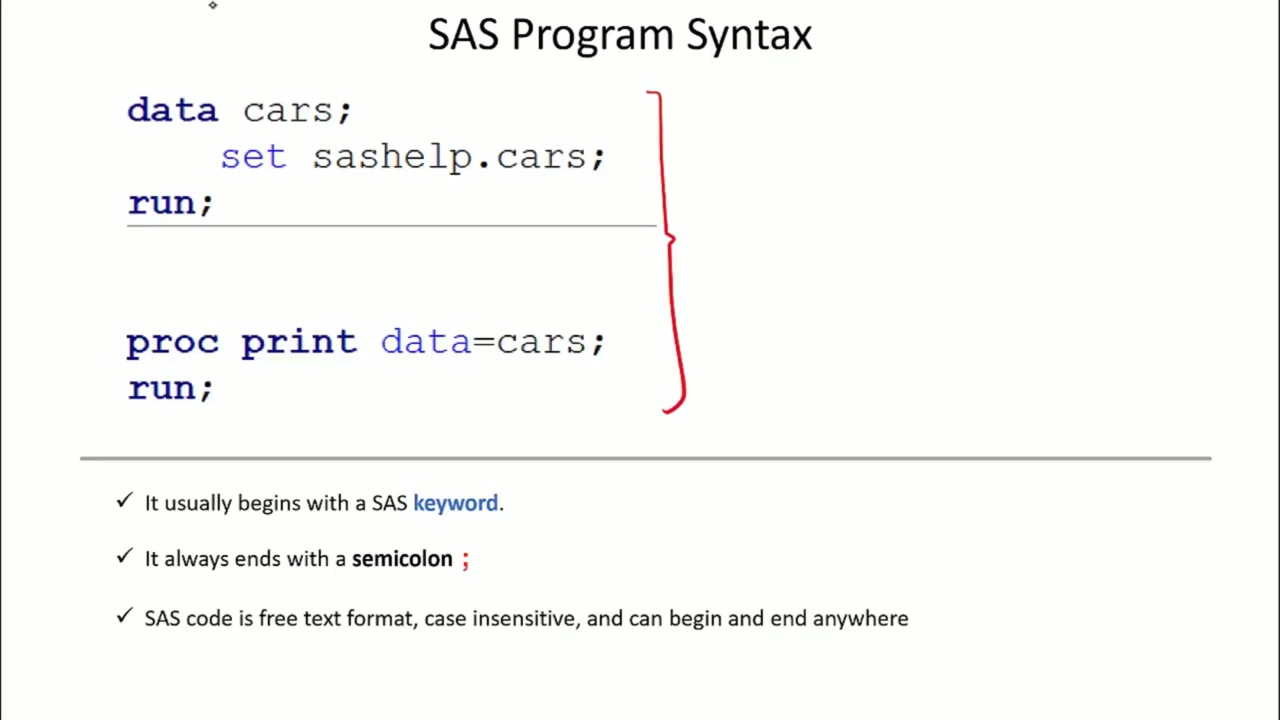
A SAS program consists of a sequence of DATA steps and PROC steps made up of SAS statements. Every SAS statement must begin with an identifying keyword (such as DATA, SET, PROC, RUN) and must always end with a semicolon (;). SAS syntax is case-insensitive and free-format.
Why Statement Syntax & Parsing Mechanics Matter in Production
Syntax errors account for over 60% of beginner programming bugs. Knowing how the SAS word scanner parses tokens and detects semicolons is crucial for troubleshooting in SAS Studio and batch environments.
Standard Syntax, Derivation & Framework Pattern
/* SAS Statement Structure Example */
DATA work.employee_salaries;
    SET sashelp.class;
    WHERE Age >= 13;
    Monthly_Allowance = Weight * 2.5;
RUN;

PROC PRINT DATA=work.employee_salaries;
    TITLE "Filtered Youth Allowance Roster";
RUN;
Core Rules
- Every statement ends with a semicolon (;). Omitting a semicolon causes subsequent statements to be interpreted as options.
- SAS is case-insensitive for keywords and variable names, but case-sensitive inside quoted text strings.
- Programs are composed of DATA steps (data ingestion and manipulation) and PROC steps (statistical analysis and reporting).
- Global statements (e.g. OPTIONS, TITLE, FOOTNOTE, LIBNAME) remain active until changed or the session ends.
Related Architectural Concepts & Next Steps
Deepen your mastery with connected topics across our curriculum and knowledge hubs.
Frequently Asked Questions (FAQ)
What happens if you forget a semicolon in SAS?
If a semicolon is omitted, SAS combines the line with the following statement into a single command, often resulting in syntax errors such as 'Statement is not valid or it is used out of proper order'.
Is SAS syntax case-sensitive?
SAS keywords, dataset names, and variable names are case-insensitive. However, text inside quotation marks (string literals) is strictly case-sensitive.
Want complete video breakdowns & exercises?
Explore full step-by-step masterclass training in The Simplest Guide to SAS Programming.