
SAS RETAIN Statement vs. SUM Statement Accumulators
Preserve values across DATA step iterations without resetting to missing.
📌 Direct Answer / Executive Definition
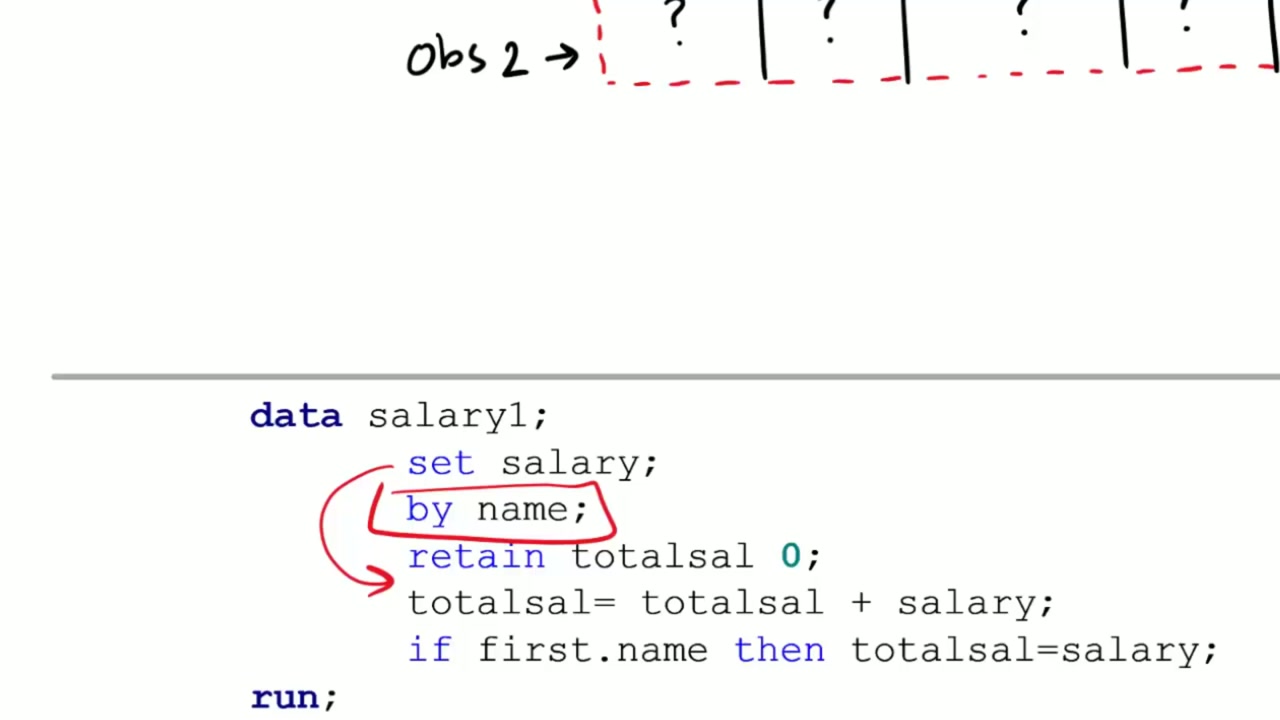
The RETAIN statement prevents SAS from re-initializing specified variable values to missing at the beginning of each DATA step iteration. The SUM statement (variable + expression) implicitly retains the accumulator variable, initializes it to 0, and automatically treats missing values as zero.
Why RETAIN & Accumulator Logic Matter for Longitudinal Analytics
Crucial for calculating running totals, tracking state across patient visits, and building complex lag/lead indicators in clinical and financial analytics.
Standard Syntax, Derivation & Framework Pattern
/* Calculating Running Totals: RETAIN vs SUM Statement */
DATA work.running_totals;
    SET sashelp.class;

    /* Method 1: Explicit RETAIN */
    RETAIN Total_Age 0;
    Total_Age = Total_Age + Age;

    /* Method 2: SUM Statement (Implicit RETAIN & missing value safety) */
    Running_Weight + Weight;
RUN;
Core Rules & Certification Takeaways
- RETAIN variable-name initial-value; preserves values across rows until explicitly updated.
- The SUM statement (var + expr) is shorthand for: RETAIN var 0; var = SUM(var, expr);
- The SUM statement treats missing values as 0, whereas standard addition (+) with a missing value returns missing.
- RETAIN is frequently paired with BY-group processing (FIRST.variable / LAST.variable).
🔗 Related Architectural Concepts & Next Steps
Deepen your mastery with connected topics across our curriculum and knowledge hubs.
Frequently Asked Questions (FAQ)
What is the key advantage of the SUM statement over the assignment statement with RETAIN?
The SUM statement automatically ignores missing values (treating them as 0), whereas standard arithmetic addition (+) returns a missing value if any operand is missing.
When does the RETAIN statement take effect?
The RETAIN statement takes effect during compilation, setting an internal flag in the PDV descriptor that prevents the variable from being reset during the execution loop.
Want complete video breakdowns & exercises?
Explore full step-by-step masterclass training in The Simplest Guide to SAS Programming.