
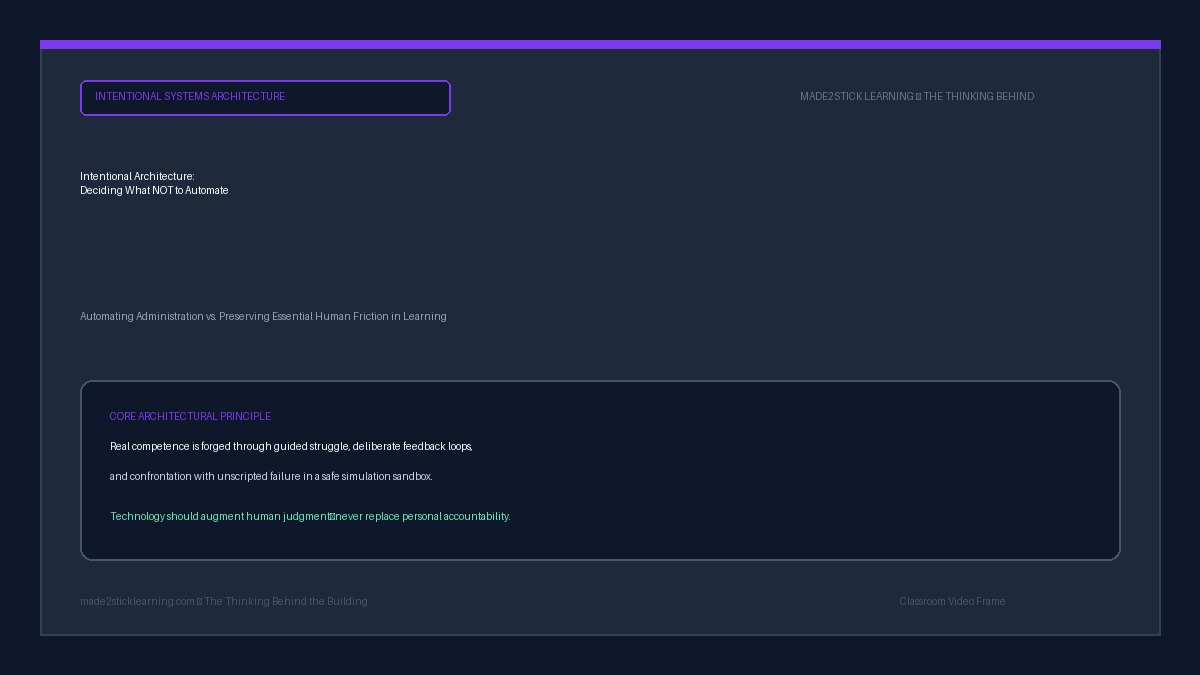
Intentional Architecture: Deciding What NOT to Automate
The engineering discipline of preserving human friction where it creates value.
Intentional architecture is the design strategy of deliberately choosing which parts of a system should remain manual or human-driven. In education and enterprise delivery, preserving human friction creates resilience, comprehension, and psychological ownership.
Why Deliberate Friction & Intentional Architecture Matter in Systems Design #
Indiscriminate automation often increases fragility, obscures system failure modes, and strips away the exact cognitive friction that enables deep mastery.
Standard Syntax, Derivation & Framework Pattern #
/* Automation Decision Matrix */
┌─────────────────────────────┬─────────────────────────────┐
│ AUTOMATE (High Leverage)    │ PRESERVE MANUAL (High Value)│
├─────────────────────────────┼─────────────────────────────┤
│ - Static Site Generation    │ - Personal instructor reply │
│ - Unit testing & linting    │ - Core pedagogical friction │
│ - Audit report generation   │ - Strategic decision gates  │
│ - Schema validation checks  │ - Direct student coaching   │
└─────────────────────────────┴─────────────────────────────┘
Core Rules #
- Just because a process can be automated does not mean it should be automated.
- In educational systems, automating the struggle out of learning destroys the student's ability to retain the concept.
- In engineering systems, full automation often turns low-frequency edge cases into catastrophic black-box failures.
- High-performance teams automate repetitive overhead so they can invest concentrated human attention on high-judgment decisions.
Frequently Asked Questions (FAQ) #
How do you decide what should not be automated?
Ask: 'Does the friction in this step create understanding, trust, or safety?' If yes, automating it reduces system value. If the friction is purely administrative toil, automate it.
Why does Made2Stick preserve direct human email replies?
Because authentic mentorship and personalized feedback build lasting trust and reveal student friction points that automated chatbots completely miss.
Want complete video breakdowns, code files & exercises?
Explore comprehensive step-by-step masterclass training in our authoritative WorkReady Workplace Simulations.