
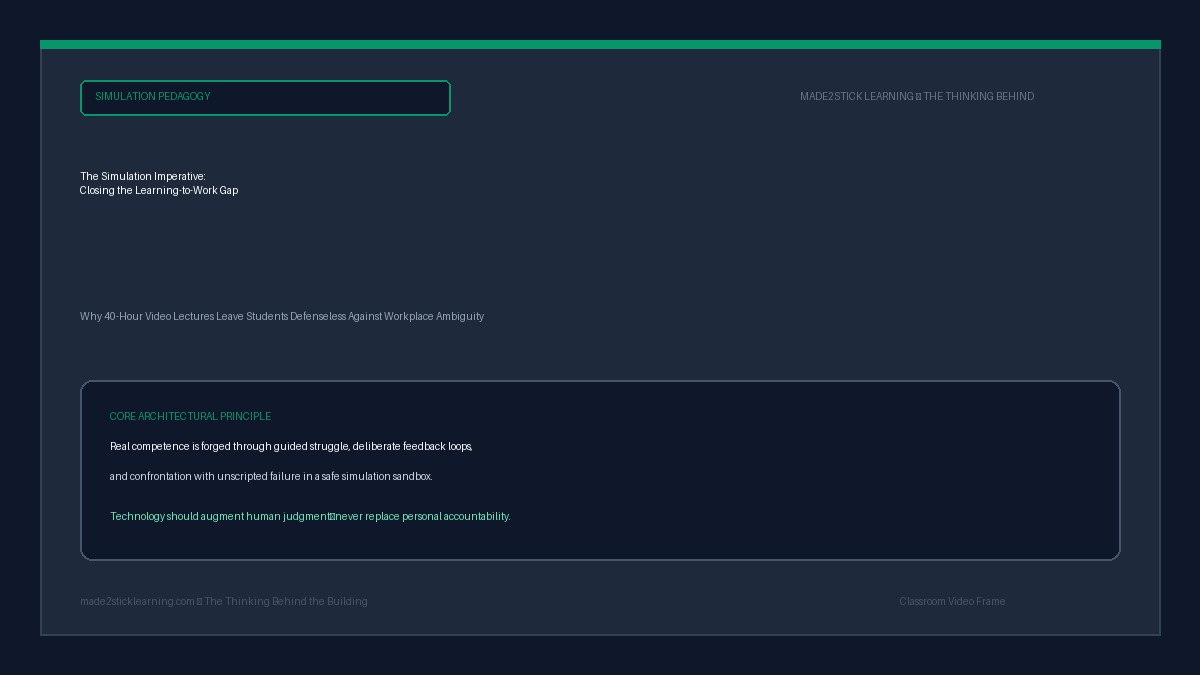
The Simulation Imperative: Why Practice Beats Video Lectures
How interactive scenarios solve the post-completion freeze in professional careers.
Workplace simulation pedagogy is an instructional methodology that immerses learners in realistic, unscripted job scenarios featuring messy inputs, conflicting stakeholder demands, and live debugging environments. It targets the learning-to-work gap that passive video lectures cannot bridge.
Why Realistic Workplace Simulation Matters for Career Readiness #
Certification exams measure pattern recognition and syllabus coverage, but on-the-job success depends on handling ambiguity, missing documentation, and production errors under pressure.
Standard Syntax, Derivation & Framework Pattern #
/* WorkReady Simulation Execution Model */
1. INBOX: Synthetic Project Manager issues urgent request with incomplete specs.
2. ARTIFACTS: Student reviews dirty raw data log & protocol requirements.
3. EXECUTION: Student investigates the root-cause bug in a live browser IDE.
4. VALIDATION: Multi-step programmatic rubric verifies functional & regulatory accuracy.
5. DEBRIEF: Immediate diagnostic feedback pinpoints exact rationale failure.
Core Rules #
- Watching an expert solve a problem on video builds familiarity, but familiarity is not competence.
- The most critical professional skills (handling ambiguous requirements, resolving edge-case bugs, stakeholder pushback) cannot be taught via multiple-choice quizzes.
- Simulations allow practitioners to make expensive mistakes in a zero-risk sandbox where failure triggers immediate diagnostic learning.
- Workplace performance depends on emotional resilience under uncertainty, which can only be developed through active scenario practice.
Frequently Asked Questions (FAQ) #
What is the learning-to-work gap?
The learning-to-work gap is the disconnect between passing a certification exam or completing a course and being able to independently execute tasks during the first week on a live job.
How do WorkReady simulations measure competency?
WorkReady uses step-based validation rubrics that check both output correctness and process compliance (e.g. audit trails, defensive coding, stakeholder communication) rather than simple text matching.
Want complete video breakdowns, code files & exercises?
Explore comprehensive step-by-step masterclass training in our authoritative WorkReady Workplace Simulations.