
Adverse Events (AE) Safety Reporting & ADAE Derivations
How to program Treatment-Emergent Adverse Events (TEAEs) and MedDRA hierarchical summary tables.
📌 Direct Answer / Executive Definition
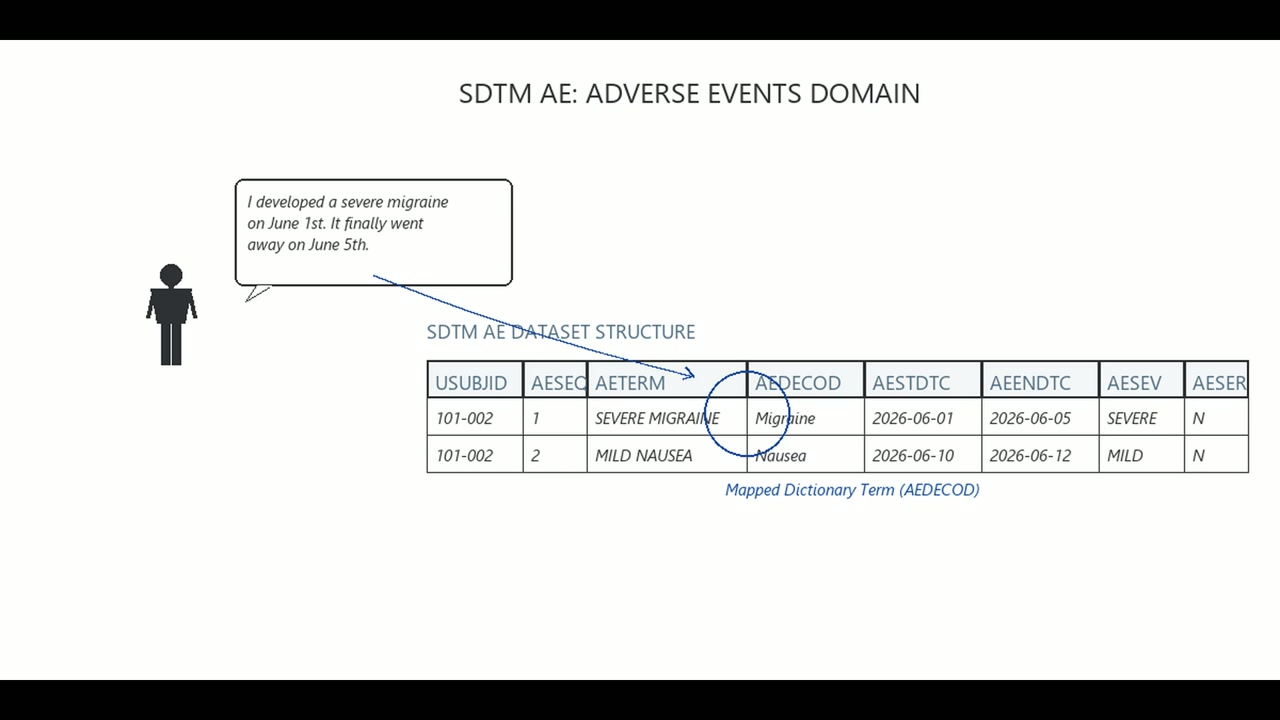
Treatment-Emergent Adverse Events (TEAEs) are untoward medical occurrences that begin or worsen after the first dose of investigational study medication. Clinical SAS programmers derive TEAE flags (TRTEMFL) in ADAE and generate incidence summary tables grouped by MedDRA System Organ Class (SOC) and Preferred Term (PT).
Why ADAE Derivations & Safety Reporting Matter for Regulatory Approval
Safety reporting directly determines whether a novel pharmaceutical candidate receives regulatory approval or is placed on clinical hold by the FDA.
Standard Syntax, Derivation & Framework Pattern
/* Deriving Treatment-Emergent Flag (TRTEMFL) in ADAE */
DATA adam.adae;
    MERGE sdtm.ae(IN=in_ae) adam.adsl(KEEP=USUBJID TRTSDT TRTEDT TRT01A TRT01AN SAFFL IN=in_adsl);
    BY USUBJID;
    IF in_ae AND in_adsl;

    AESTDT = INPUT(AESTDTC, IS8601DA.);
    AEENDT = INPUT(AEENDTC, IS8601DA.);

    /* TEAE: Start date on or after treatment start, or worsening */
    IF AESTDT >= TRTSDT THEN TRTEMFL = 'Y';
    ELSE TRTEMFL = 'N';
RUN;
Core Rules & Certification Takeaways
- MedDRA hierarchy: System Organ Class (SOC) → High-Level Group Term (HLGT) → High-Level Term (HLT) → Preferred Term (PT).
- Adverse event incidence counts subjects, not events: A subject with 3 headaches in the same arm is counted exactly once at the PT level.
- Serious Adverse Events (SAEs) require immediate fast-track expedited reporting within 24–48 hours.
- AE tables are sorted by descending total frequency of SOC, and alphabetically or by descending frequency of PT.
🔗 Related Architectural Concepts & Next Steps
Deepen your mastery with connected topics across our curriculum and knowledge hubs.
Frequently Asked Questions (FAQ)
What defines a Treatment-Emergent Adverse Event (TEAE)?
An adverse event that occurs after receiving the first dose of study treatment (AESTDT >= TRTSDT) or an existing condition that worsens in severity during the active treatment phase.
In an AE table, if a subject experiences 4 episodes of nausea, what is the count?
The count is 1. Standard clinical AE incidence tables count the number and percentage of unique subjects who experienced the event, not the total event count.
Want complete video breakdowns & exercises?
Explore full step-by-step masterclass training in Clinical SAS Programming & Clinical Trials.