
Risk Breakdown Structure (RBS): Hierarchical Categorization & Risk Concentration in PMP®
Master hierarchical risk decomposition, prompt lists (PESTLE/TECOP), and aggregate risk concentration scoring.
A Risk Breakdown Structure (RBS) is a hierarchical representation of potential sources of project risk, organized by risk categories and subcategories. Modeled after the Work Breakdown Structure (WBS), the RBS decomposes high-level risk domains (Level 1: Technical, Project Management, Organizational, External) down to granular subcategories (Level 2: Requirements, Technology, Estimates, Subcontractors, Regulatory). In PMP® governance, the RBS is an output of the Plan Risk Management process and is utilized during Identify Risks as a structured prompt list and during Qualitative Risk Analysis to identify hidden Risk Concentration.
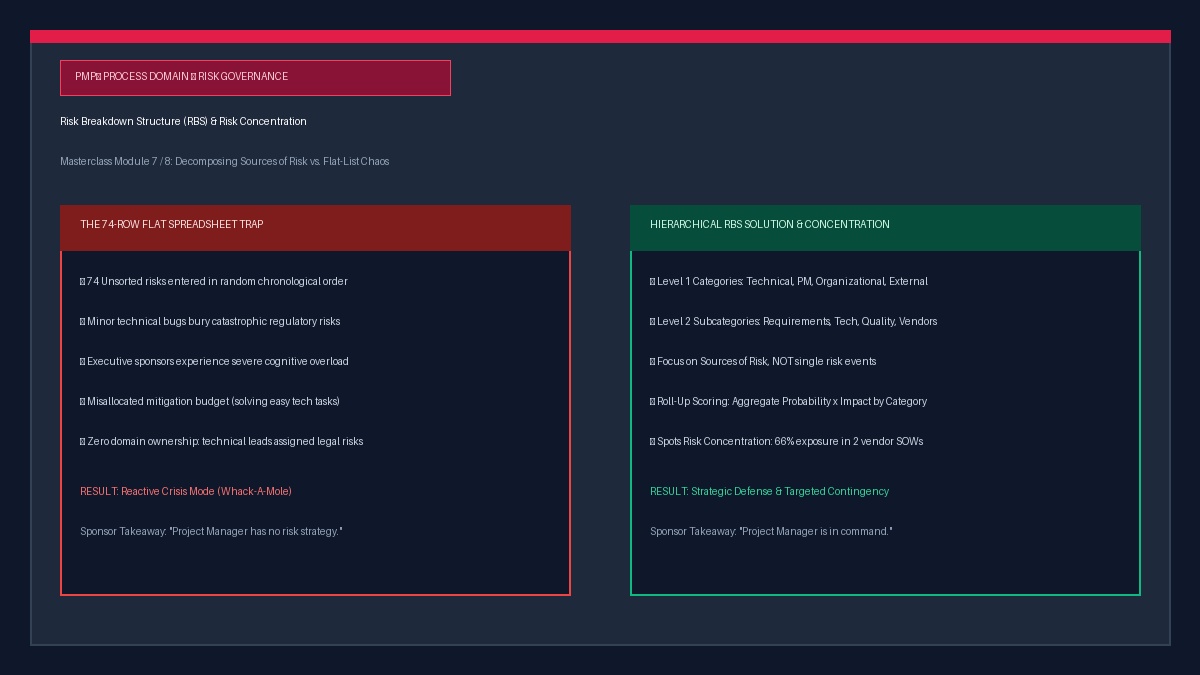
Why Hierarchical RBS Decomposition Matters for Enterprise Risk Management #
Presenting a flat list of 74 unsorted risks to an executive sponsor causes cognitive overload and masks critical vulnerabilities. Grouping risks hierarchically allows project managers to roll up probability and impact scores across domains—revealing, for example, that while 60% of identified risks are minor internal bugs, 70% of total financial exposure is concentrated in two external vendor contracts.
Standard Syntax, Derivation & Framework Pattern #
/* 4-LEVEL HIERARCHICAL RISK BREAKDOWN STRUCTURE (RBS) & CONCENTRATION */

Level 0: Total Project Risk Exposure
├── 1.0 TECHNICAL RISK
│   ├── 1.1 Requirements (Unclear user stories, shifting scope boundaries)
│   ├── 1.2 Technology Limits (Unproven legacy tech, third-party API throttling)
│   ├── 1.3 System Complexity (Distributed microservices, asynchronous state)
│   └── 1.4 Quality & Performance (Database indexing latency, data integrity)
├── 2.0 PROJECT MANAGEMENT RISK
│   ├── 2.1 Estimating (Optimistic duration bias, student syndrome)
│   ├── 2.2 Planning & WBS (Missing work packages, sequencing bottlenecks)
│   ├── 2.3 Resource Allocation (Key person dependency, paired engineering gaps)
│   └── 2.4 Communication Gaps (Stakeholder misalignment, unrecorded decisions)
├── 3.0 ORGANIZATIONAL RISK
│   ├── 3.1 Project Dependencies (Upstream data feeds, shared infrastructure)
│   ├── 3.2 Funding & Budget (Mid-cycle portfolio reallocations, cash flow)
│   ├── 3.3 Prioritization (Competing strategic initiatives, sponsor departure)
│   └── 3.4 Governance & Culture (Resistance to change, approval paralysis)
└── 4.0 EXTERNAL RISK
    ├── 4.1 Subcontractors & Vendors (T&M cost escalation, SLA breaches)
    ├── 4.2 Regulatory & Compliance (FDA 21 CFR Part 11, GDPR privacy audits)
    ├── 4.3 Market Shifts (Competitor feature parity, currency/inflation fluctuations)
    └── 4.4 Environmental & Weather (Supply chain port strikes, site closures)

/* RISK CONCENTRATION SCORING FORMULA: */
Category Exposure = Σ (Probability x Impact) for all risks within RBS Branch
Core Rules #
- Sources vs. Events: The RBS categorizes the sources of risk (e.g., 4.1 Subcontractors), whereas the Risk Register documents specific risk events (e.g., Vendor X fails delivery).
- Prompt List Generator: During Identify Risks, use the RBS alongside PESTLE (Political, Economic, Social, Technological, Legal, Environmental) and TECOP to uncover blind spots.
- Uncovering Risk Concentration: Roll up risk scores (Probability x Impact) by RBS branch to see where overall project vulnerability is concentrated.
- Plan Risk Management Output: The RBS is created and tailored during Plan Risk Management and forms part of the Risk Management Plan.
- Assigning Domain Ownership: Categorizing risks allows the PM to assign logical risk owners—technical leads own 1.0, procurement owns 4.1, and finance owns 3.2.
How hierarchical decomposition transforms flat spreadsheet noise into executive risk intelligence.
Frequently Asked Questions (FAQ) #
What is the primary difference between a WBS and an RBS?
A Work Breakdown Structure (WBS) decomposes project deliverables and scope (what is being built), whereas a Risk Breakdown Structure (RBS) decomposes potential sources of project risk (where uncertainties originate).
In which PMBOK process is the Risk Breakdown Structure (RBS) created?
The RBS is created during the Plan Risk Management process as a core component of the Risk Management Plan. It is later used as a tool in Identify Risks and Perform Qualitative Risk Analysis.
What is 'Risk Concentration' and how does the RBS reveal it?
Risk concentration occurs when a disproportionate amount of a project's overall risk exposure clusters within a single domain. By aggregating the risk scores (Probability × Impact) of individual risks under their corresponding RBS branches, project managers can objectively identify if, for instance, 70% of project risk lies in vendor contracts rather than software engineering.
How does an RBS prevent 'flat register blindness' on enterprise projects?
A flat spreadsheet list of 50–100 risks treats all problems as an unsorted pile, causing executive sponsors to glaze over and missing catastrophic dependencies. The RBS groups risks by operational origin, enabling targeted risk response planning, domain-specific risk owners, and focused contingency reserve allocation.
Want complete video breakdowns, code files & exercises?
Explore comprehensive step-by-step masterclass training in our authoritative Project Management Fundamentals.