
Implicit vs. Explicit OUTPUT Statement in SAS DATA Step
Controlling when and where observations are written to output datasets.
📌 Direct Answer / Executive Definition
By default, SAS performs an implicit OUTPUT at the end of every DATA step iteration. Specifying an explicit OUTPUT statement overrides and disables this default behavior, writing an observation to one or more output datasets only at the exact point of the OUTPUT statement.
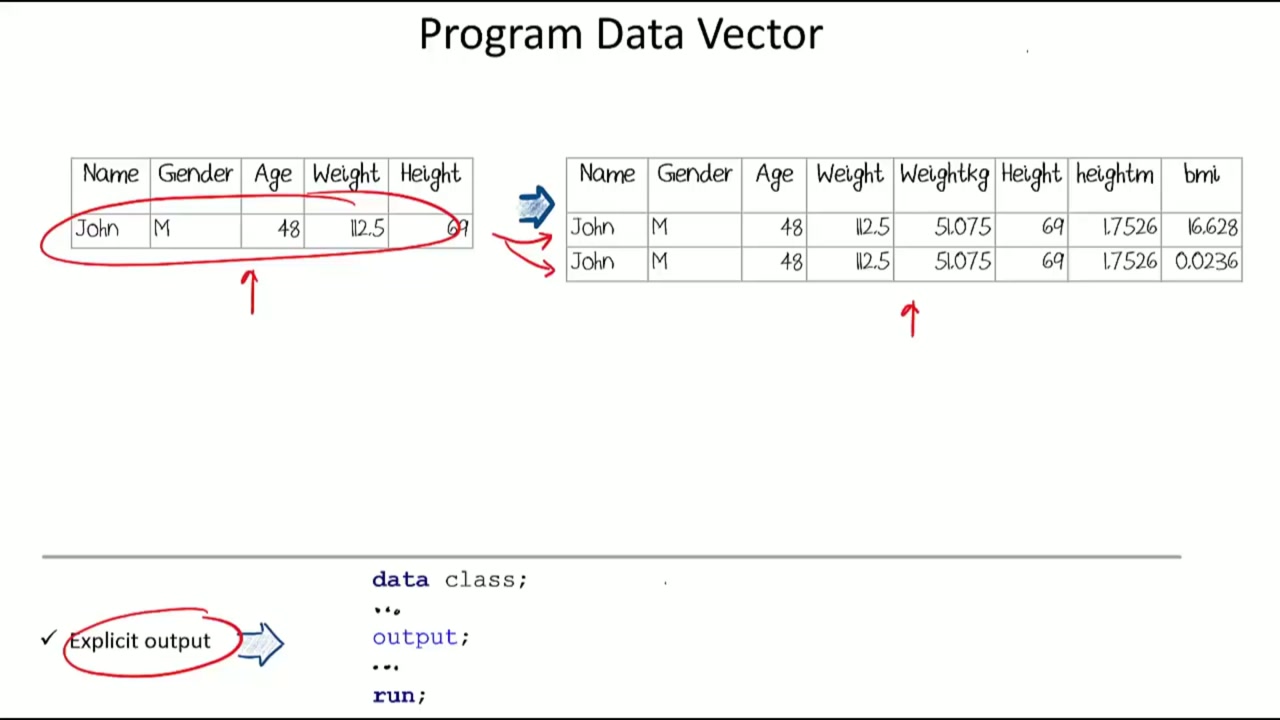
Why Controlling Output Writes Matters in Enterprise Data Pipelines
Explicit OUTPUT enables splitting a single input dataset into multiple filtered targets in a single pass, transposing columns into multiple rows, and creating lookup tables efficiently.
Standard Syntax, Derivation & Framework Pattern
/* Splitting into Multiple Datasets with Explicit OUTPUT */
DATA work.teens work.preteens work.adults;
    SET sashelp.class;

    IF Age < 13 THEN OUTPUT work.preteens;
    ELSE IF Age <= 15 THEN OUTPUT work.teens;
    ELSE OUTPUT work.adults;
RUN;
Core Rules & Certification Takeaways
- An implicit OUTPUT occurs automatically at the bottom of the DATA step (before the RUN statement).
- As soon as an explicit OUTPUT statement is added, the automatic implicit output is completely disabled.
- A single input observation can generate multiple output rows by calling OUTPUT multiple times inside a DO loop.
- Direct specific rows to target tables using: OUTPUT dataset_name;
🔗 Related Architectural Concepts & Next Steps
Deepen your mastery with connected topics across our curriculum and knowledge hubs.
Frequently Asked Questions (FAQ)
What happens to the implicit OUTPUT when you write 'OUTPUT;' in a DATA step?
The default implicit OUTPUT at the end of the DATA step is immediately deactivated. Observations will only be written where the OUTPUT statement is executed.
Can you output to multiple datasets in a single DATA step?
Yes. Declare all dataset names in the DATA statement, then use conditional IF-THEN logic followed by 'OUTPUT dataset_name;'.
Want complete video breakdowns & exercises?
Explore full step-by-step masterclass training in The Simplest Guide to SAS Programming.